
Lost & found · Found-bird help
Found a bird? We’ll help you take the next step.
Thank you for stopping to help. Follow the steps below, or use our found-bird helper. It asks a few questions, tells you how to care for the bird, and checks the registry for its owner.
Use the found-bird helperOnly seen a loose bird, not caught it? Report a sighting. We’ll let the owners of similar birds reported missing nearby know.
Already reported a bird? Lost your link? We’ll email it to you again.
Step 01 of 07 · Health
If the bird is hurt or unwell, take it to a vet now.
Look for any of these signs:
- Bleeding, a drooping wing, or it can’t stand or perch
- Fluffed up, eyes closing, or sitting still on the ground
- Breathing with its mouth open or its tail bobbing
- It has been in a cat’s or dog’s mouth, even with no visible wound
If it’s a wild bird, a licensed wildlife rescue can also help, such as WIRES in NSW. The helper lists rescues for your state.
Step 02 of 07 · Safety
Keep it safe and calm
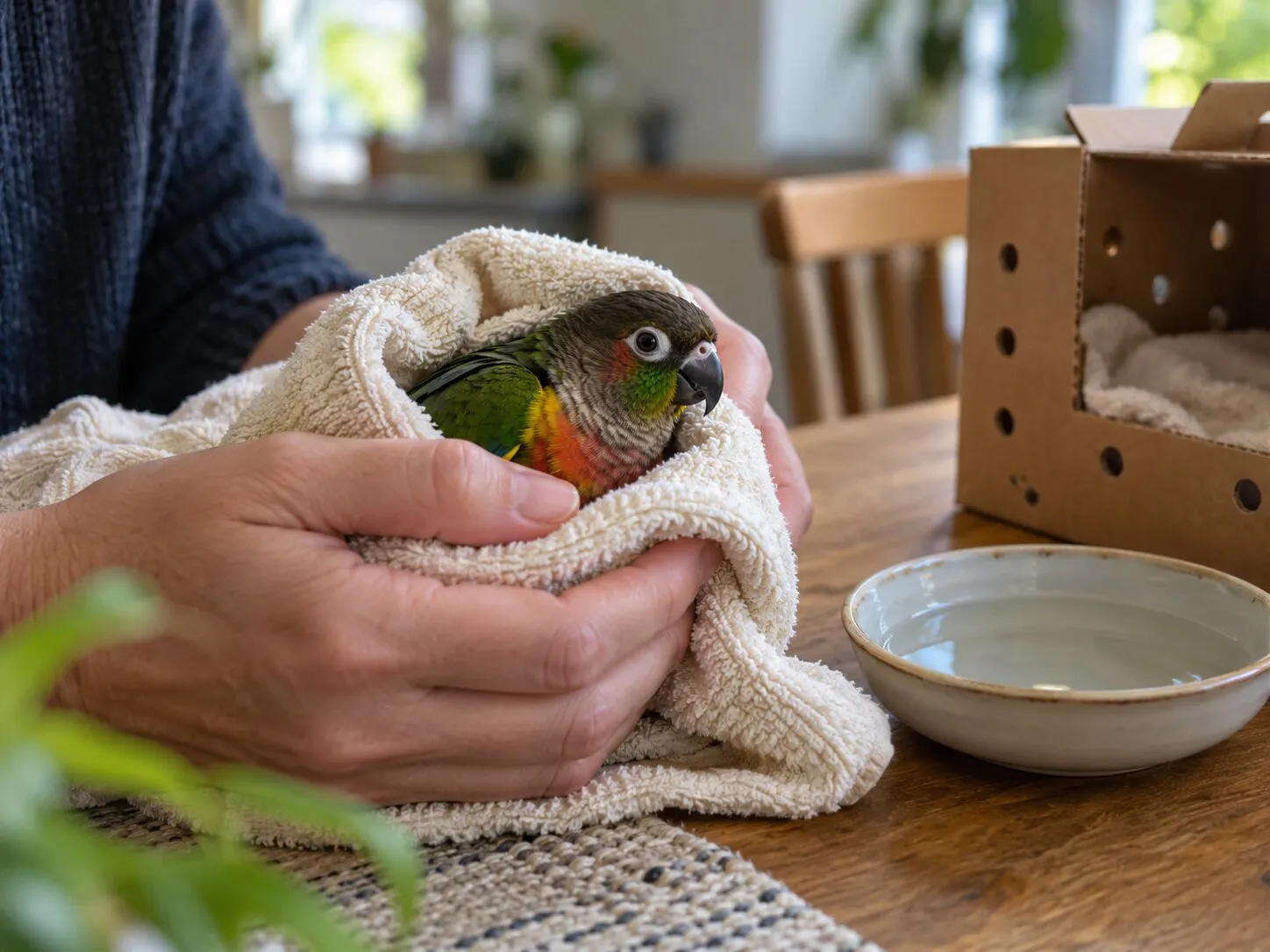
A frightened bird can injure itself or fly off again. Contain it gently, then give it time to settle.
- Use a cardboard box with air holes, a pet carrier or a spare cage. Line it with a towel.
- Keep it somewhere quiet, warm and dim, away from pets, children, fans and direct sun.
- Keep it away from your own birds. Some bird illnesses spread easily between birds.
- When handling, cover it with a light towel. Don’t squeeze its chest: birds need to move their chest to breathe.
- Wash your hands after handling.
Step 03 of 07 · Wild or pet
Is it wild, or someone’s pet?
This can be hard to tell. Many Australian species, such as galahs, lorikeets, corellas and cockatoos, live wild and are kept as pets.
Probably a pet
- Calm around people, or steps onto a hand
- Wearing a leg band
- Talks, whistles tunes or mimics sounds
- Clipped wing feathers or struggles to fly far
- A species or colour that doesn’t live wild near you, such as a blue budgie in a city
Probably wild
- Panics and tries hard to get away from people
- A local species with natural colouring, often with its flock nearby
- A young bird on the ground with parents calling overhead (it may be learning to fly)
If it’s wild, contact a licensed wildlife rescue or take it to a vet. In most of Australia you need a licence to keep native wildlife, and wildlife carers know how to return birds to the wild. If you’re not sure, a vet can take a look.
Step 04 of 07 · Care
Water and food, for now
A healthy bird can manage a day without food while you get help, but it does need water. What it eats depends on what kind of bird it is. The helper will suggest food once you’ve told us the species.
- Water: offer a shallow dish. Never drip or squirt water into a bird’s beak; it can inhale it.
- Budgies, cockatiels, finches and most parrots eat seed. A plain seed mix from a supermarket or pet shop is fine short-term.
- Lorikeets don’t eat seed. They feed on nectar and pollen. A pet shop lorikeet mix is best; don’t give seed, bread or honey.
- Not sure what it eats? Offer water only and ask a vet.
Never give a bird avocado, chocolate, coffee or tea, alcohol, salty food, milk or bread. Some of these are toxic to birds even in small amounts.
Step 05 of 07 · Identification
Check for a leg band
Look closely at both legs. A band is a small ring around the leg, usually metal or coloured aluminium. Its letters and numbers are the bird’s best chance of getting home.
Examples only. Real bands vary in format, colour and size.
- Take a photo with your phone and zoom in. It’s easier than reading a moving bird.
- Write down every letter and number, in order, plus the band’s colour. If you can’t read a character, that’s fine; you can leave it out.
- Don’t try to remove the band. Closed bands are fitted when a bird is a chick and can’t come off without injury.
Some bands belong to other schemes
- A plain metal band with a Canberra address is from the Australian Bird and Bat Banding Scheme, used on wild birds for research. Report it to the scheme.
- A racing pigeon usually has a band starting with its club’s letters, like ANPA or VHA. Pigeon associations reunite their own birds; the ANPA lost pigeon page explains what to do.
Step 06 of 07 · No identifier
No band? It can still get home.
- Ask a vet or shelter to scan for a microchip. Larger parrots are often chipped, and you can’t see or feel the chip.
- Report it to BIRD anyway. We compare its species, colours, photos and location with birds reported missing, and alert owners of possible matches.
- Spread the word locally. Post in local lost-bird groups and on ParrotAlert. The helper suggests groups for your area.
- Note exactly where and when you found it. Owners often search close to home.
Step 07 of 07 · Report
Report it to BIRD
The helper takes you through everything above, step by step, and then checks the registry.
-
If there may be a match
We alert the owner privately and pass on their reply through BIRD.
-
If there’s no match yet
We keep checking new missing-bird reports and point you to local help.
-
Your privacy
Your contact details are only used to reach you about this bird.
BIRD isn’t a veterinary service. This guide is general information, offered in good faith to help until you can reach a vet or wildlife rescue, and it isn’t a substitute for professional advice. If in doubt, see a vet. Band numbers aren’t always unique across issuers, so a match means the owner is asked to confirm; it isn’t proof of ownership.